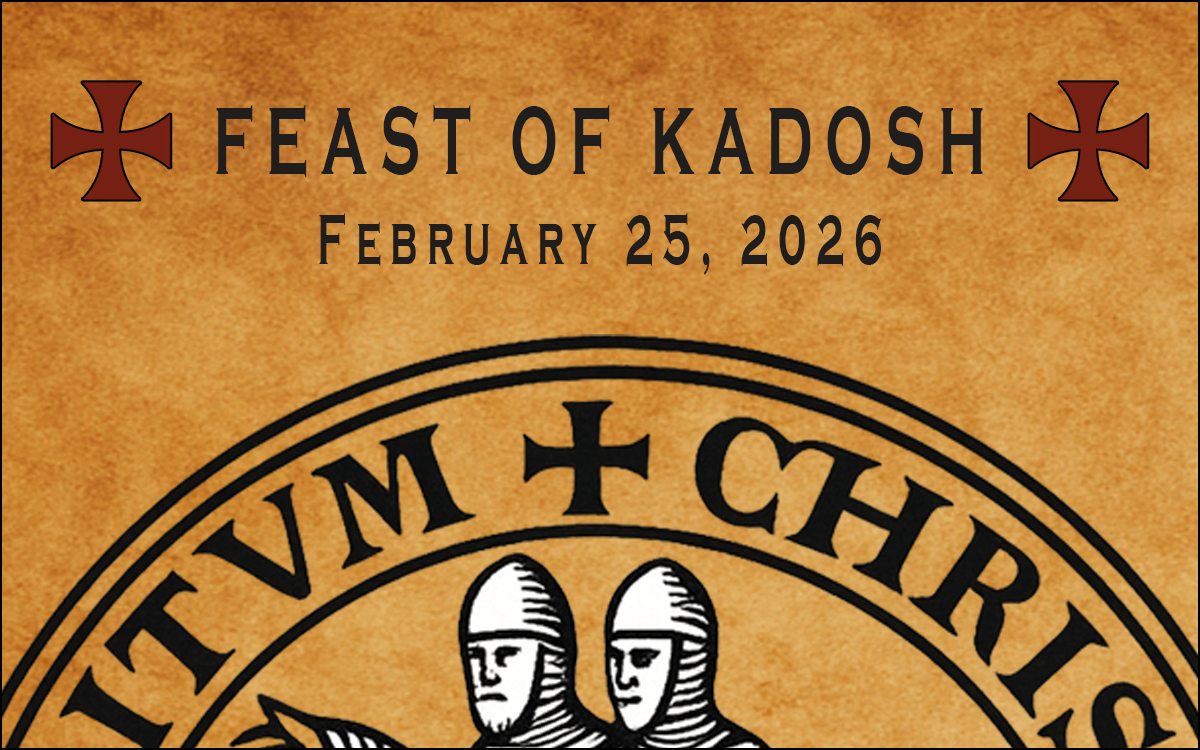
FEAST OF KADOSH 2026
Do not miss the Valley’s first Feast of Kadosh.
The Feast of Kadosh commemorates a moment of profound historical and spiritual significance: the founding of the order of the Poor Fellow-Soldiers of Christ and of the Temple of Solomon, known to us as the Knights Templar, on the 18th day of January, in the year of our Lord 1119.
The Origins of the Feast of Kadosh

The Feast of Kadosh commemorates a moment of profound historical and spiritual significance: the founding of the order of the Poor Fellow-Soldiers of
Christ and of the Temple of Solomon, known to us as the Knights Templar, on the 18th day of January, in the year of our Lord 1119.
Born amidst the fervor of the Crusades, the Knights Templar rose as champions of Christendom in the twelfth and thirteenth centuries, earning renown not only as a formidable military order, but as one of the most powerful and wealthy institutions of the medieval world. Officially sanctioned by the Roman Catholic Church at the Council of Troyes in 1129, the Order expanded rapidly in both membership and influence, becoming a vital presence throughout Christian Europe and the Holy Land.
In the aftermath of the First Crusade’s capture of Jerusalem in 1099, pilgrims flocked to the sacred sites of the Holy Land. Yet their paths were fraught with peril, as bands of marauders and highwaymen preyed upon the faithful.
To shield these devoted travelers, the French knight Hugues de Payens petitioned King Baldwin II of Jerusalem to establish a mona herhood of warrior-monks. Thus, the Order of the Temple was born, headquartered in a wing of the royal palace on the revered Temple Mount, believed to be the site of Solomon’s Temple.
The Knights Templar soon transcended their martial role. They forged a vast financial and logistical network that stretched across the known world. With lands spanning both Europe and the Levant, they managed estates, vineyards, and farms; they erected fortresses and sanctuaries; they engaged in commerce and industry, maintained their own fleet of ships, and at one time held dominion over the island of Cyprus. In their operations and reach, they became perhaps the world’s first multinational enterprise, a temporal power rooted in spiritual purpose. Yet as the tide of history shifted, so too did the fortunes of the Order.

By the mid-12th century, the unity of the Crusader states began to fracture. The Islamic world grew stronger and more cohesive, while rivalries emerged among the Christian Orders. Tensions mounted between the Knights Templar and their counterparts, the Teutonic Knights and the Hospitallers. In 1305, Pope Clement V summoned Jacques de Molay, the Grand Master of the Knights Templar, and Fulk de Villaret of the Hospitallers, ostensibly to consider a union of their Orders. But hidden beneath these diplomatic overtures were dark undercurrents. De Molay stood accused of heresy, and Pope Clement sought the counsel of King Philip IV of France, a monarch deep in debt to the Knights Templar and eager to destroy them.
Then, on the ill-fated morning of Friday the 13th, October 1307, King Philip struck. In a coordinated and ruthless purge, he ordered the mass arrest of Templars across France, including Grand Master de Molay. The charges were grave, heresy, apostasy, idolatry, and other unspeakable crimes. Under the cruel lash of torture, many confessed, though the truth of such admissions remains shrouded in darkness. Under pressure from the French crown, Pope Clement ultimately disbanded the Order by papal bull in 1312. Yet justice would not be served.
On March 18, 1314, Jacques de Molay and Geoffroi de Charney, Preceptor of Normandy, recanted their forced confessions and upheld the honor of the Order. For their defiance, they were led to the stake and perished in flames, martyrs to a cause greater than kings or pontiffs.
Thus, in the Scottish Rite, the Feast of Kadosh stands not only as a remembrance of the Knights Templar’s founding, but as a sacred observance of their enduring legacy. It celebrates the eternal ideals of chivalry, virtue, honor, and moral rectitude, principles the Knights Templar embodied, and which continue to illuminate the path of
Freemasonry.
Their Order may have fallen to the machinations of power, but their light has not been extinguished. It burns still, reflected in the teachings of the Rite, and honored in the hearts of all who walk the way of the Knight.
Source is based on Commander Casey Fletcher, 32° K.C.C.H, Director of Work, Ancient and Accepted Scottish Rite, Valley of Tampa.
The Origins of the Feast of Kadosh
The Feast of Kadosh commemorates a moment of profound historical and spiritual significance: the founding of the order of the Poor Fellow-Soldiers of
Christ and of the Temple of Solomon, known to us as the Knights Templar, on the 18th day of January, in the year of our Lord 1119.
Born amidst the fervor of the Crusades, the Knights Templar rose as champions of Christendom in the twelfth and thirteenth centuries, earning renown not only as a formidable military order, but as one of the most powerful and wealthy institutions of the medieval world. Officially sanctioned by the Roman Catholic Church at the Council of Troyes in 1129, the Order expanded rapidly in both membership and influence, becoming a vital presence throughout Christian Europe and the Holy Land.
In the aftermath of the First Crusade’s capture of Jerusalem in 1099, pilgrims flocked to the sacred sites of the Holy Land. Yet their paths were fraught with peril, as bands of marauders and highwaymen preyed upon the faithful.
To shield these devoted travelers, the French knight Hugues de Payens petitioned King Baldwin II of Jerusalem to establish a mona herhood of warrior-monks. Thus, the Order of the Temple was born, headquartered in a wing of the royal palace on the revered Temple Mount, believed to be the site of Solomon’s Temple.
The Knights Templar soon transcended their martial role. They forged a vast financial and logistical network that stretched across the known world. With lands spanning both Europe and the Levant, they managed estates, vineyards, and farms; they erected fortresses and sanctuaries; they engaged in commerce and industry, maintained their own fleet of ships, and at one time held dominion over the island of Cyprus. In their operations and reach, they became perhaps the world’s first multinational enterprise, a temporal power rooted in spiritual purpose. Yet as the tide of history shifted, so too did the fortunes of the Order.
By the mid-12th century, the unity of the Crusader states began to fracture. The Islamic world grew stronger and more cohesive, while rivalries emerged among the Christian Orders. Tensions mounted between the Knights Templar and their counterparts, the Teutonic Knights and the Hospitallers. In 1305, Pope Clement V summoned Jacques de Molay, the Grand Master of the Knights Templar, and Fulk de Villaret of the Hospitallers, ostensibly to consider a union of their Orders. But hidden beneath these diplomatic overtures were dark undercurrents. De Molay stood accused of heresy, and Pope Clement sought the counsel of King Philip IV of France, a monarch deep in debt to the Knights Templar and eager to destroy them.
Then, on the ill-fated morning of Friday the 13th, October 1307, King Philip struck. In a coordinated and ruthless purge, he ordered the mass arrest of Templars across France, including Grand Master de Molay. The charges were grave, heresy, apostasy, idolatry, and other unspeakable crimes. Under the cruel lash of torture, many confessed, though the truth of such admissions remains shrouded in darkness. Under pressure from the French crown, Pope Clement ultimately disbanded the Order by papal bull in 1312. Yet justice would not be served.
On March 18, 1314, Jacques de Molay and Geoffroi de Charney, Preceptor of Normandy, recanted their forced confessions and upheld the honor of the Order. For their defiance, they were led to the stake and perished in flames, martyrs to a cause greater than kings or pontiffs.
Thus, in the Scottish Rite, the Feast of Kadosh stands not only as a remembrance of the Knights Templar’s founding, but as a sacred observance of their enduring legacy. It celebrates the eternal ideals of chivalry, virtue, honor, and moral rectitude, principles the Knights Templar embodied, and which continue to illuminate the path of
Freemasonry.
Their Order may have fallen to the machinations of power, but their light has not been extinguished. It burns still, reflected in the teachings of the Rite, and honored in the hearts of all who walk the way of the Knight.
Source is based on Commander Casey Fletcher, 32° K.C.C.H, Director of Work, Ancient and Accepted Scottish Rite, Valley of Tampa.